Roman Architectural Use
The Romans used white marble from the Apuan Alps extensively in the imperial period. The material supplied cladding for public buildings, columns for temples, and decorative panels for both interior and exterior surfaces. Roman builders distinguished between marble used structurally — as load-bearing columns, for example — and marble used as surface cladding over a rubble or brick core. Carrara stone was employed in both roles.
The Pantheon in Rome, completed during the reign of Hadrian in the early second century CE, incorporates white marble in its portico floor and in interior surface treatments. The precise sourcing of these marbles is still debated in the archaeometric literature — Roman builders used stone from multiple Italian and Greek quarries, and visual identification alone does not confirm origin. Isotopic analysis of certain Pantheon elements has suggested Carrara provenance for some portions of the white marble used, though the evidence is not uniform across studies.
What is less contested is the scale of Roman logistics involved in moving large-format stone from Carrara to building sites across the peninsula. The port at Luni (Carrara Marina) functioned as a transshipment point, and inscriptions on some Roman-period blocks record quarry ownership and supply chain information.

The Pantheon portico, Rome. White marble appears in the floor and several surface elements. Isotopic studies have suggested Carrara provenance for portions of this stone. Source: Wikimedia Commons / CC BY-SA
Medieval Ecclesiastical Architecture
In the medieval period, white marble from Carrara appears consistently in Tuscan ecclesiastical architecture. The Pisan Romanesque style — characterised by horizontal bands of alternating white and coloured marble — made extensive use of Carrara white for its contrast with imported verde di Prato and other banded stones. The Cathedral of Pisa, the Baptistery, and the Campo Santo complex all incorporate Carrara marble in substantial quantities.
The constructional logic of this period used marble both as a structural element and as a facing material. The Cathedral of Santa Maria del Fiore in Florence, begun in 1296, uses white Carrara marble as one of three colours in its polychrome facade — the others being green Prato serpentine and pink Maremma stone. This combination, standardised by the fourteenth century, became the visual signature of Florentine Gothic architecture and was replicated in several other Tuscan churches.

Facade of the Cathedral of Santa Maria del Fiore, Florence. White panels are Carrara Bianco; green elements are serpentine from Prato. Source: Wikimedia Commons / CC BY-SA
Renaissance Sculpture
The Renaissance period associated Carrara marble specifically with sculpture at the highest level. The translucency of Statuario grade — the property that allows light to penetrate a few millimetres into the stone surface before reflecting, producing a skin-like visual depth — was valued by sculptors for figurative work. No other commercially available white stone shared this characteristic to the same degree.
Michelangelo's documented preference for selecting blocks personally at Carrara is recorded in letters and in contemporary accounts. He travelled to the Fantiscritti basin on multiple occasions and complained in correspondence about the quality of stone supplied by intermediaries. The Pietà in St. Peter's Basilica in Rome, carved between approximately 1498 and 1499, is generally attributed to Statuario from the Carrara quarries, selected by the sculptor before carving began.
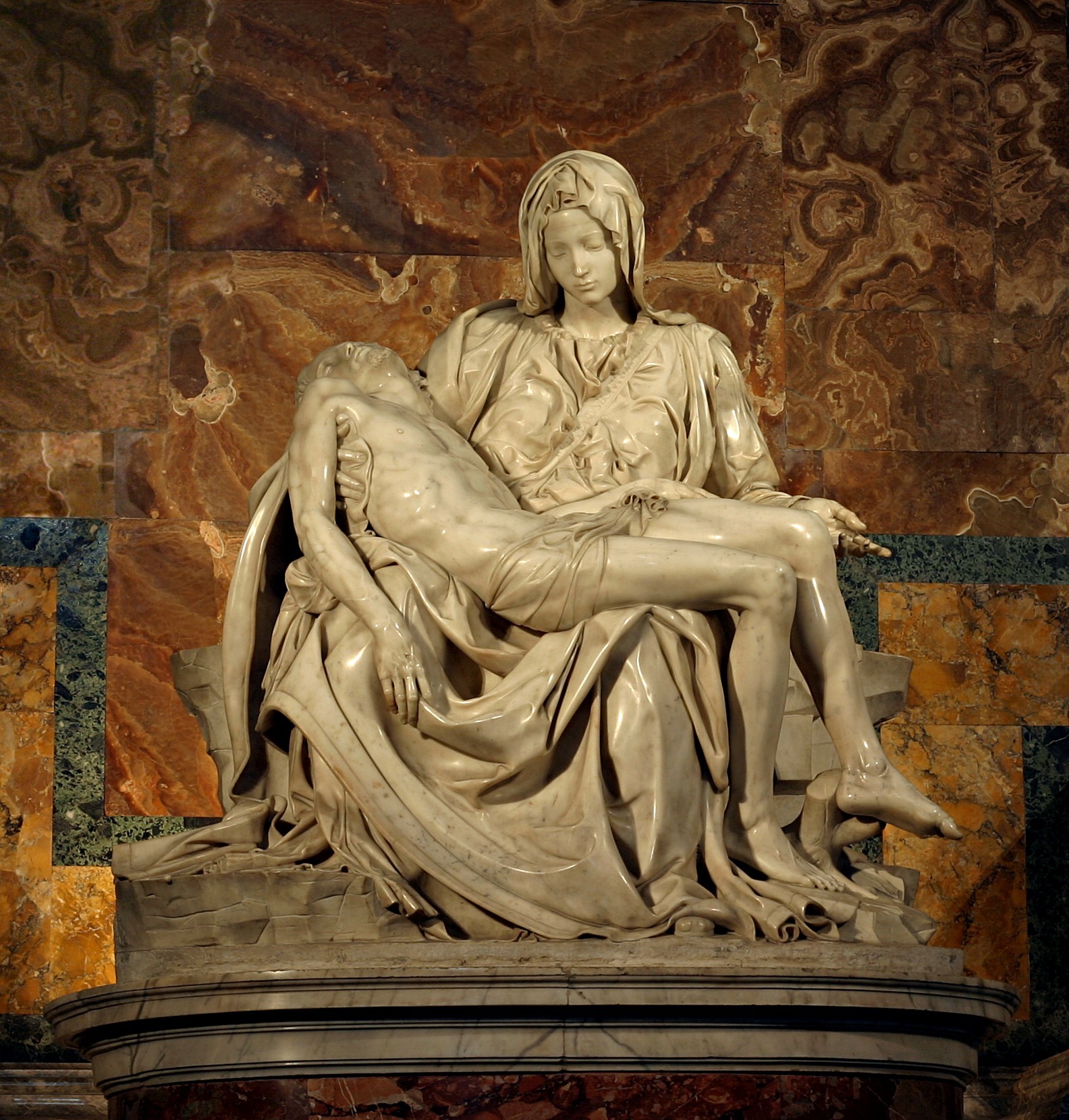
Michelangelo's Pietà, St. Peter's Basilica, Rome. The translucency of the Statuario grade is visible in the surface of the figures under raking light. Source: Wikimedia Commons / CC BY-SA
Nineteenth and Twentieth-Century Monumental Construction
The expansion of marble export in the nineteenth century brought Carrara stone into a wider range of architectural contexts. The material appeared in European and North American courthouses, banks, opera houses, and railway stations constructed during periods of civic building ambition. For this class of building, marble was primarily a cladding material — thin slabs attached to a structural frame of brick, iron, or concrete — rather than a load-bearing element.
The Vittoriano monument in Rome, constructed between 1885 and 1935, represents one of the largest uses of Carrara marble in modern monumental architecture. The white stone — Bianco Botticino from Brescia rather than Carrara, as it transpired — was selected in part for its visual uniformity across large areas of facade. The specification of marble for this scale of project drove demand for consistent colour matching across multiple delivery lots, a logistical challenge that pushed quarry operators toward greater quality control in block selection.
Marble in Restoration Practice
The use of Carrara marble in restoration projects presents different technical requirements from new construction. A replacement element must not only match the structural function of the original but must also match its visual character — colour, surface texture, veining pattern, and finish — sufficiently to be imperceptible in context. For historic Italian buildings, this typically means specifying a Carrara grade that corresponds to the stone originally used, which in many cases is Bianco or Statuario from the same geological formation.
Restoration Specification Factors
- Crystal grain size — affects surface reflectivity and tactile character
- Background colour — Carrara whites range from pure white to warm grey; must match weathered original
- Vein density and colour — critical for polychrome facades
- Finish — polished, honed, or tooled; historic elements often show specific toolmark patterns
- Block orientation — grain direction affects how the stone weathers; should match original
The Museo del Marmo in Carrara maintains a reference collection of over 300 named varieties and their geological origins. Conservators working on Italian historic buildings can compare reference samples against the stone in place to identify the most appropriate supply source for replacements. In some cases, the relevant quarry face has been exhausted, and a close geological equivalent from a neighbouring basin must be substituted.
Differential Weathering as a Restoration Constraint
A technical difficulty in marble restoration is the differential weathering between aged original stone and newly supplied replacement. Marble exposed to the atmosphere undergoes surface carbonation, biological colonisation (lichen, algae, biofilm), and soiling from particulate pollution. A new element of matching grade will be visually distinct from the surrounding aged material for a period of years after installation.
Conservators address this in different ways depending on the context. In some cases the replacement element is intentionally left to weather naturally, with the expectation that it will integrate over time. In others, pre-ageing treatments — controlled carbonation, selective surface weathering — are applied to reduce the visual contrast from installation. The appropriate approach depends on the significance of the building and the expectations of the responsible authority.